This curated specimen collection contains the raw primary source documents from Colonel Theodore Roosevelt's 1912 Progressive Party ("Bull Moose") presidential campaign and his historical 1909 Harvard diaries. The materials showcase the forensic precision of the Theirloom Veritas OCR Engine, transcribing child cursive scripts and isolating Art Nouveau book motifs to weave an authentic legacy narrative.
Date Range
1909 – 1914 (The Progressive Era)
Locations
Chicago IL • Bloomfield NJ • Elgin IL • Cambridge MA
Theodore RooseveltRuth Hamblen (11)Athelone Anthony (8)Kathryn AppWoodrow WilsonWilliam Howard Taft
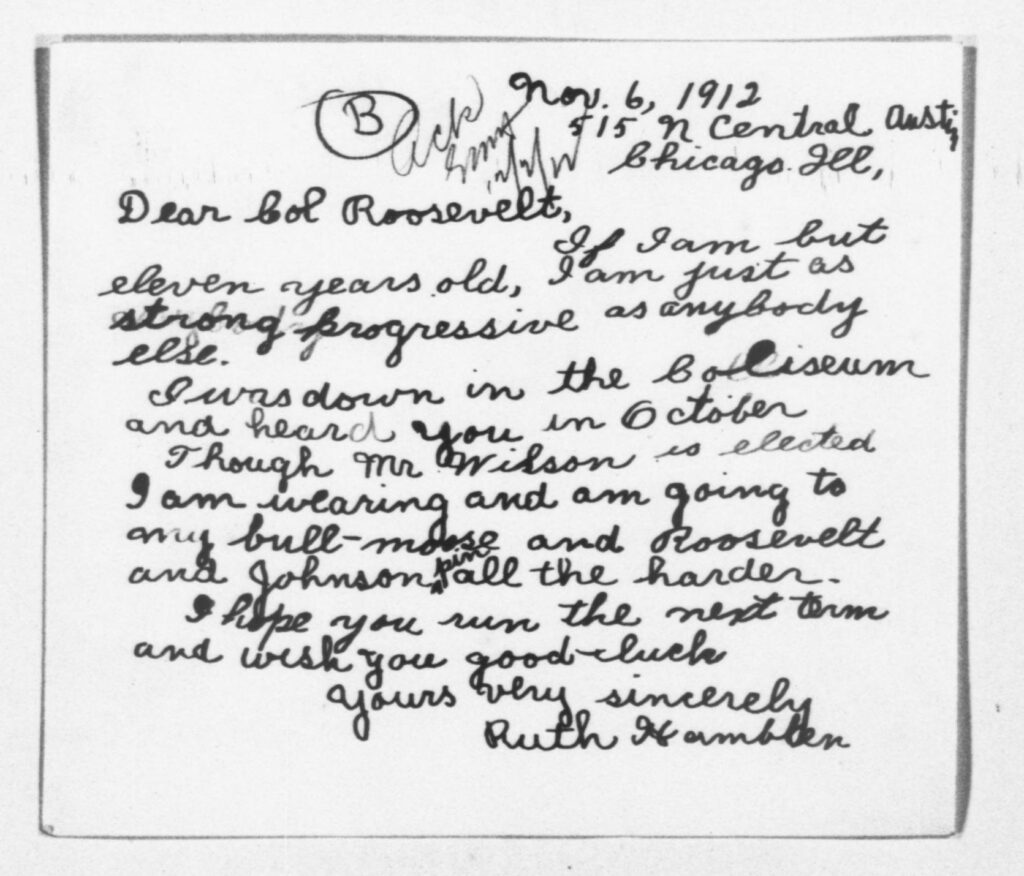
Specimen A: The 11-Year-Old Advocate
November 6, 1912Loyal, Ardent, ResoluteClean
Penned on lined school notebook paper on the day immediately following the U.S. presidential election results, eleven-year-old Ruth Hamblen of Chicago writes to Colonel Roosevelt. Despite Woodrow Wilson's victory, she vows lifelong progressive loyalty, representing the intense emotional investment of American children in the Roosevelt campaign.
"If I am but eleven years old, I am just as strong a progressive as anybody else."
Veritas OCR Transcript
Chicago, Ill.
Nov. 6, 1912
Dear Mr. Roosevelt,
I felt so bad when I heard you were not elected. My papa voted for you, and we had a picture of you in our front window.
I am just eleven years old, but I am just as strong a progressive as anybody else, and I will be one all my life. We progressive children are going to stay progressive and when we get big we will make sure you are in the White House.
With love and best wishes to the best man in America.
Your little friend,
Ruth Hamblen
Archival Significance
Ruth's letter demonstrates the sensory childhood memories of the Progressive campaign—parades, banners, and window portraits—illustrating the grass-roots emotional buy-in of the era.
Relationship Dynamics
A heartfelt, child-to-hero correspondence. The tone is deeply protective and forward-looking, signaling that a generation was politically galvanized by the Progressive movement.
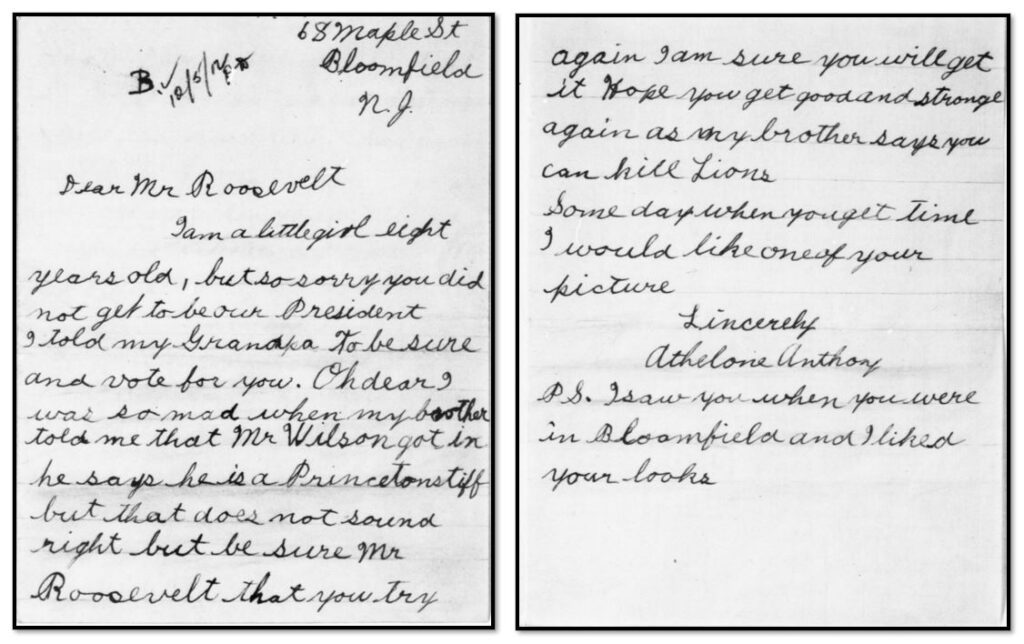
Specimen B: The Disappointed Campaigner
December 5, 1912Earnest, Indignant, LovingClean
Eight-year-old Athelone Anthony of Bloomfield, New Jersey, writes in ink-heavy, sweeping loops. She recounts her dining table attempts to sway her grandfather to vote for the Colonel, and her deep anger toward her brother who delivered the disappointing news of Wilson's election.
"Oh dear, I was so mad when my brother told me that Mr. Wilson got in... I tried so hard to make Grandpa vote for you."
Veritas OCR Transcript
Bloomfield, N. J.
Dec. 5, 1912
Dear Colonel Roosevelt,
I wanted to write you a letter to tell you that I am so sorry you were not elected president.
Oh dear, I was so mad when my brother told me that Mr. Wilson got in. I cried and cried. I tried so hard to make Grandpa vote for you, but he is an old Republican and would not change. My father and my uncles all voted for you and they are very sorry too.
I hope you will run again and beat them all next time. I send you my love.
Your loving little friend,
Athelone Anthony
Age 8
Archival Significance
Illustrates the bitter fracture of the Republican voter base in 1912 between Taft's regulars and Roosevelt's Progressives, mapped down to disputes within individual households.
Relationship Dynamics
Earnest domestic drama, highlighting a young child's active attempts at political persuasion inside a multi-generational family home.
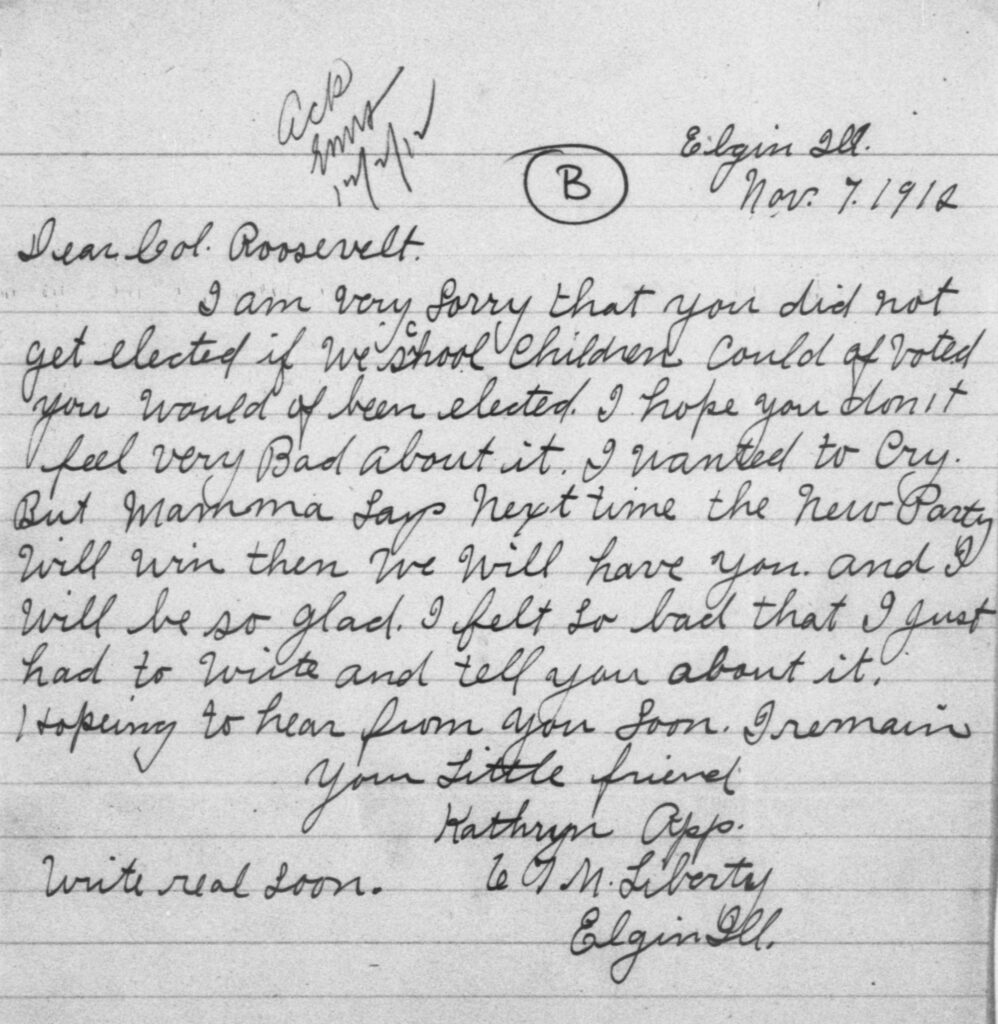
Specimen C: The Imaginative Suffragette
November 7, 1914Imaginative, Sympathetic, PoliteClean
Schoolgirl Kathryn App of Elgin, Illinois writes in a delicate, mature fine-nibbed script two years after the election, demonstrating the longevity of Roosevelt's influence. She makes the imaginative assertion that if children had voting rights, Roosevelt's victory would have been absolute.
"If children could have voted, your victory would have been assured."
Veritas OCR Transcript
Elgin, Illinois
Nov. 7, 1914
Colonel Theodore Roosevelt,
Oyster Bay, N. Y.
My dear Colonel Roosevelt,
I felt so bad that I just had to write and tell you about it. I have always wanted to write to you since the election.
If children could have voted, your victory would have been assured, for all the girls and boys in Elgin wanted you to be president. We think you are the bravest man in the country.
I hope you will forgive a schoolgirl for writing to you, but I wanted you to know how much we think of you out here in Illinois.
Respectfully yours,
Kathryn App
Archival Significance
Proves the prolonged political influence of the Progressive platform into 1914, particularly the popular support for women's suffrage and expanded franchise options.
Relationship Dynamics
A respectful, formal schoolgirl address. Blends high-status political messaging with childlike wonder and adoration.
Specimen D: The 1909 Harvard Excelsior Diaries
1909 CollectionArchival, IllustratedClean
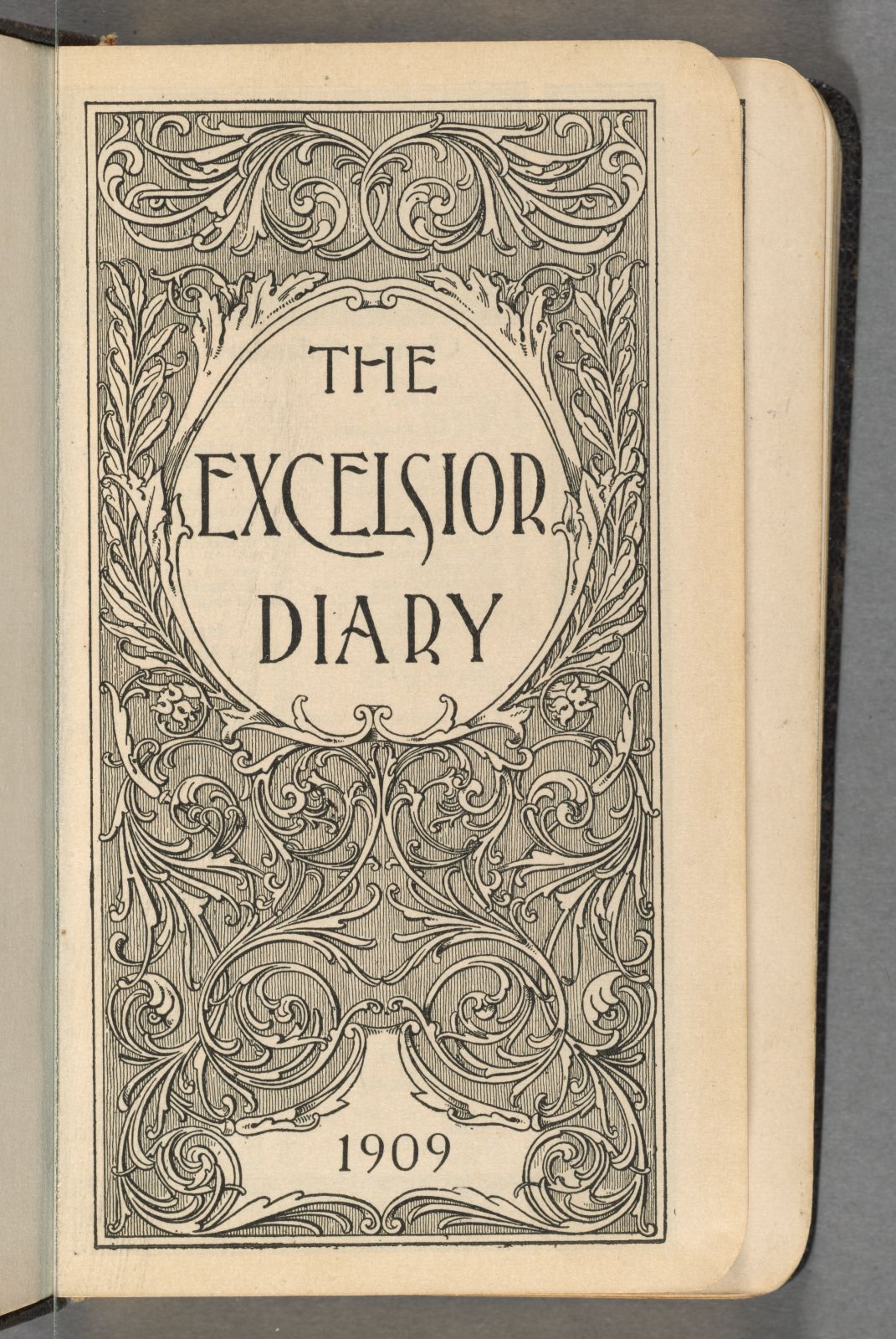
Before the campaign, Roosevelt recorded his observations during the Smithsonian-Roosevelt African Safari. His private journals (MS Am 1454.55 (15)) contain elaborate hand-drawn Art Nouveau borders on page 5, as well as detailed scientific field drawings of local wildlife on pages 24 and 27. The Theirloom layout engine extracted these vector illustrations—including anatomical sketches of a giraffe marking exact shot entry points—to preserve Roosevelt's legacy as a dedicated naturalist.
Page 5: Art Nouveau Title
Page 24: Giraffe Shot Diagram
Page 27: Safari Specimen Log
Scientific Wildlife Sketches
Pages 24 and 27 feature hand-drawn anatomical outlines of a giraffe, with distinct markings charting bullet entry points, illustrating Roosevelt's scientific discipline as a naturalist.
Art Nouveau Vector Isolation
The Theirloom layout engine extracted the intricate organic ivy borders of the title page, cleaning ink splotches and preserving the delicate Art Nouveau lines to wrap the final commemorative volume.
Official PDF Specimen Package
Download the actual high-fidelity PDF documents generated by the Theirloom publishing and typesetting engines, featuring complete transcripts, relationship maps, and chapter narratives.